You had a plan. You were going to eat clean, stick to your routine, and finally make this time different.
And then it happened.
One biscuit. One takeaway. One stressful evening where the plan went out the window.
And in that moment, a familiar thought arrived: “I’ve ruined it. Might as well start again on Monday.”
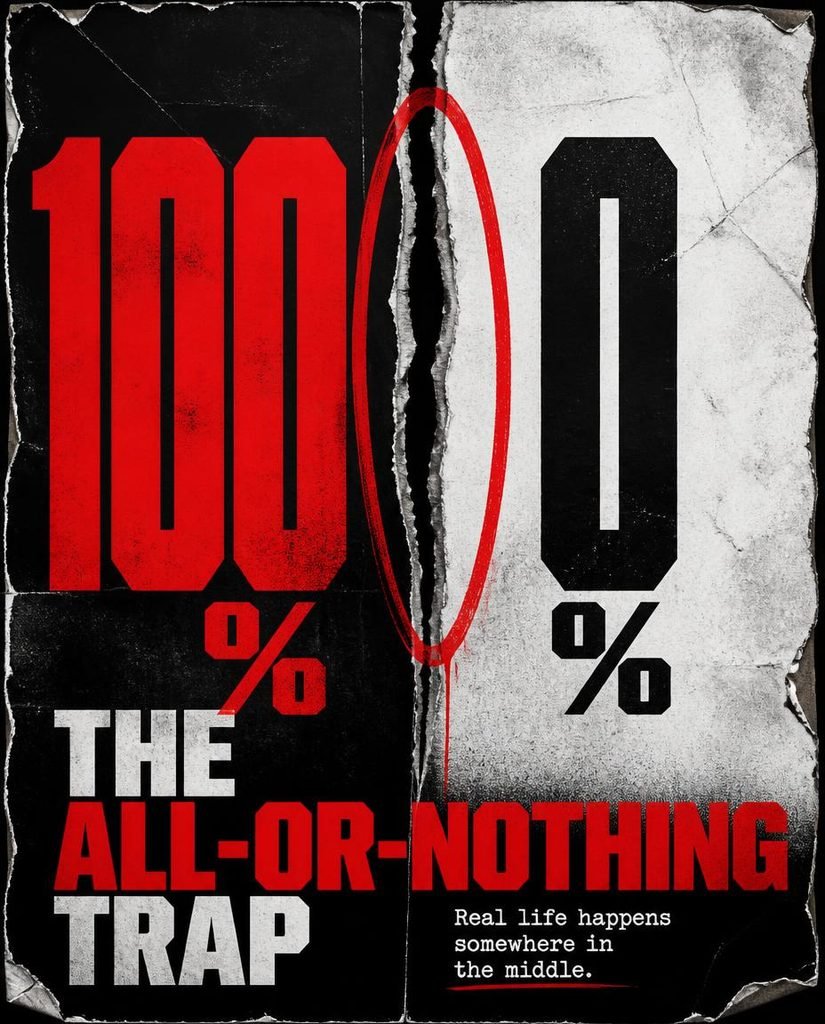
This is the all-or-nothing trap. And it’s one of the most common reasons why people who genuinely want to change end up stuck in the same cycle for years.
What Is All-or-Nothing Thinking?
All-or-nothing thinking is a cognitive pattern where things are seen in black-and-white terms. You’re either “on” the diet or “off” it. You either ate perfectly today, or you failed. There’s no middle ground.
In psychology, this is sometimes called dichotomous thinking. Research shows that this pattern is deeply connected to disordered eating behaviours. A 2025 study published in the Journal of Eating Disorders found that dichotomous thinking about food — sorting foods into strict “good” and “bad” categories — was significantly associated with binge eating, cognitive restraint, restriction, and body dissatisfaction.
In other words, the more rigidly you categorise food and yourself, the harder it becomes to maintain any kind of healthy relationship with eating.
Why One Meal Doesn’t Ruin Anything
Here’s what the all-or-nothing mind misses: your body doesn’t work in absolutes.
One meal does not undo weeks of progress. One bad day does not erase the small wins you’ve already stacked up. The human body is remarkably resilient and adaptive. It responds to patterns over time, not single events.
But the all-or-nothing mind doesn’t care about patterns. It cares about perfection. And when perfection isn’t met, it uses that as evidence for the same old story: “See? I told you I always fail.”
This is where the trap closes. You didn’t fail because of the biscuit. You failed because you interpreted the biscuit as failure — and then gave yourself permission to give up entirely.
The Real Cost of the Trap
Research on eating behaviour and weight regain found that holding dichotomous beliefs about food and eating is linked to rigid dietary restraint, which in turn makes it harder for people to maintain a healthy weight over time.
The all-or-nothing pattern doesn’t just make you feel bad. It actively undermines your ability to sustain change.
Every time you classify a day as a “failure” because of one imperfect choice, you’re reinforcing the identity of someone who can’t do this. And behaviour follows identity.
How to Break the Pattern
The good news is that all-or-nothing thinking is a learned pattern. And anything learned can be unlearned. Here are four practical steps to loosen its grip.
1. Redefine Success as “Returning,” Not “Perfection”
Instead of asking, “Did I follow the plan perfectly today?” ask, “Did I return to my intentions at some point today?”
The goal isn’t a perfect streak. The goal is the ability to come back. One imperfect moment is an event. Returning to your values is the identity.
2. Separate the Event from the Identity
When a setback happens, notice the story you’re telling yourself. “I ate a biscuit” is an event. “I’m someone who can’t control themselves” is an identity statement. One does not automatically create the other.
The gap between those two sentences is where your freedom lives.
3. Use the 80/20 Rule Instead of 100/0
The 100/0 mindset says: “If it’s not perfect, it’s worthless.” The 80/20 mindset says: “Eighty percent of my choices nourish me. Twenty percent bring me joy. Both are part of a healthy life.”
This isn’t a compromise. It’s sustainability.
4. Replace the Question, Not the Behaviour
When you catch the all-or-nothing voice, replace its question. Instead of “What’s wrong with me?” ask “What pattern am I repeating?”
One question judges. The other investigates. One closes the door. The other opens it.
Why This Matters for Lasting Change
If you want to change your relationship with food, you have to change how you interpret imperfection.
The all-or-nothing trap keeps you in a cycle of starting over because it never lets you experience the quiet power of continuing. And continuing — imperfectly, consistently, humanly — is what actually builds a new identity.
You don’t need to be perfect. You need to keep returning.
Ready to Break the Cycle?
If this resonates with you, I’ve created a free 5-minute reflection to help you see the patterns behind your habits — and start building something different.
👇 Download The 5-Minute Identity Check here:
https://payhip.com/b/3AxiC
It’s not another diet plan. It’s five minutes of honest reflection.
Mind Before Body.