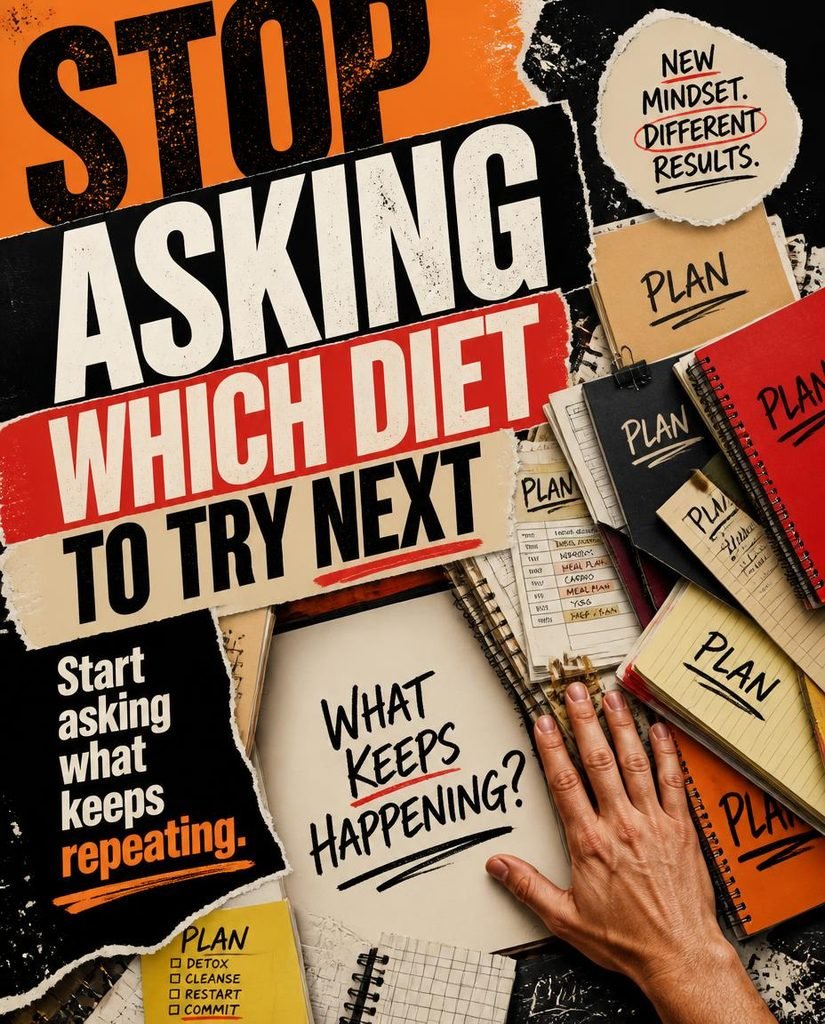
If you’ve ever asked yourself which diet to try next, you’re not alone. Keto. Intermittent fasting. Paleo. Calorie counting. The list never ends. But what if the question itself is the problem? Maybe the better question isn’t which diet to try next — maybe it’s “why do I keep needing another one?”
Why We Keep Searching for the Next Diet
Searching for a new diet feels productive. It gives you a sense of control. You buy a new book, download a new app, join a new challenge. For a few days or weeks, you feel like you’re finally on the right track.
But the pattern is always the same. The diet changes, but the outcome doesn’t. You lose some weight, then gain it back. You start strong, then fall off. And eventually, you find yourself asking the same question again: “Which diet should I try next?”
And eventually, you find yourself asking the same question again: which diet to try next?
The Real Question You Should Be Asking
Instead of asking what to eat, ask who is eating.
Because diets don’t fail. People fail to change the identity underneath the diet.
If you see yourself as someone who “always quits” or “can’t stick to anything,” no meal plan will fix that. You’ll follow the plan for a while, but eventually, your behavior will return to what matches your self-image.
This is why motivation is not a plan – it’s just a feeling. And feelings change.
The Pattern Behind the Cycle
The reason you keep needing another diet is that you haven’t addressed the pattern that makes you need one in the first place.
That pattern might be emotional eating. It might be all-or-nothing thinking. It might be the habit of using food to cope with stress, boredom, or loneliness.
These patterns don’t live in your meal plan. They live in your identity. And until you change that, you’ll keep cycling through diets, always hoping the next one will be different.
How to Break the Cycle
So how do you stop asking which diet to try next?
1. Stop looking for the perfect plan.
There is no perfect plan. There is only the plan you can actually live with – and that starts with understanding yourself, not the food.
2. Look at the pattern, not just the behavior.
When you overeat, don’t just ask “what did I eat?” Ask “what was happening before I ate?” The pattern is where the answer lives.
3. Change the identity, not just the habit.
Instead of saying “I’m trying to lose weight,” say “I’m becoming someone who takes care of their body.” Then act like that person, in small ways, every day.
4. Build systems that work when motivation doesn’t.
Motivation is unreliable. Habits are not. Build small routines that you can repeat even on your worst days. This is how habits don’t need to be huge – they just need to be repeatable.
The Identity Shift
This is the core of the Identity Shift Method. You don’t change what you eat until you change who you believe you are.
When you become someone who no longer needs to diet, the question “which diet?” disappears. You’re not following a plan anymore. You’re just living as the person you’ve become.
That’s when change stops being a struggle and starts being a side effect of who you are.
Conclusion
Stop asking which diet to try next. Start asking why you keep needing another one.
If you’re tired of the cycle, it’s time to try a different question. Not “what should I eat?” but “who am I becoming?”
Ready to stop asking and start changing?
If this resonates with you, start with the free 5-Minute Identity Check → Download the free PDF
And if you want the complete system — the book, workbook, journal, and action guide — Get the collection
Mind Before Body.