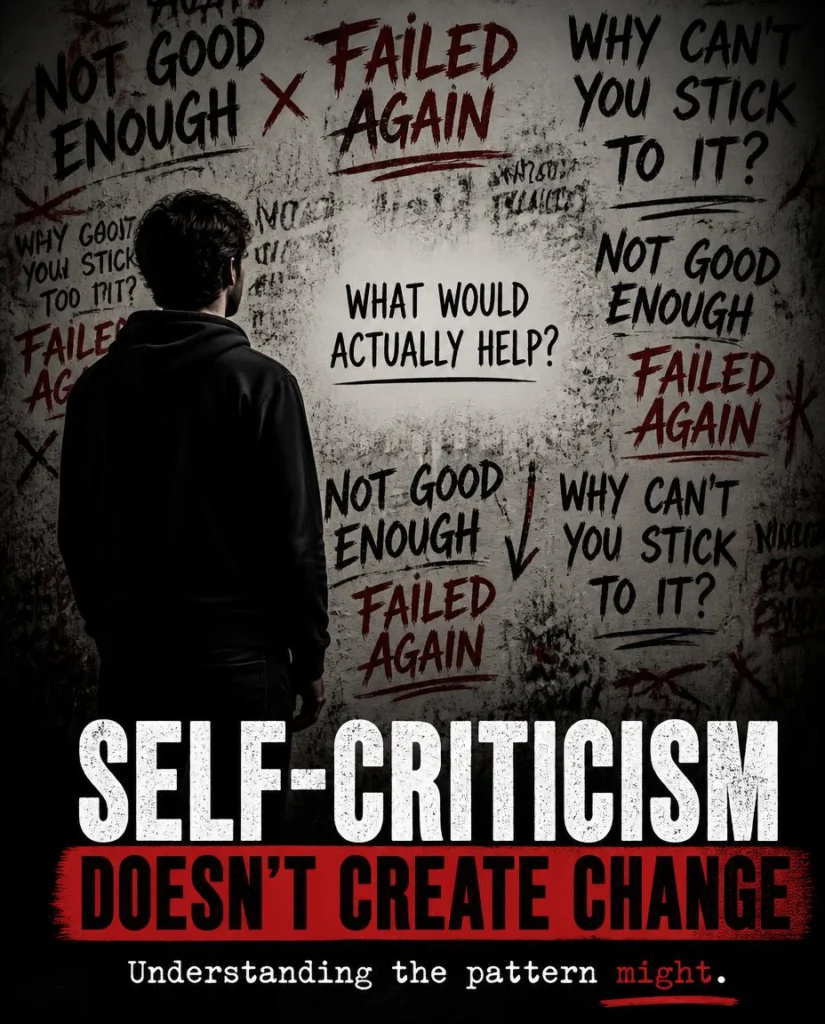
We often believe that being hard on ourselves is the only way to change. That if we just criticise ourselves enough, we’ll finally be motivated to do better. That self-punishment is the price of progress.
But here’s the truth: self-criticism doesn’t automatically create change. In fact, it often does the opposite. It keeps us stuck in shame, fear, and the same patterns we’re trying to break.
The Trap of Self-Criticism
Think about the last time you messed up. Maybe you ate something you’d promised yourself you wouldn’t. Maybe you skipped a workout. Maybe you broke a small promise to yourself.
What did you say to yourself in that moment?
If you’re like most people, you probably said something like:
- “I always do this.”
- “I have no self-control.”
- “I’ll never change.”
That voice feels familiar. It might even feel productive, like it’s holding you accountable. But it’s not. It’s just making you feel worse. And when you feel worse, you’re more likely to repeat the same behaviour, not less.
This is the cycle: you mess up, you criticise yourself, you feel ashamed, you seek comfort (often in food), and then you criticise yourself even more. The criticism doesn’t break the cycle. It feeds it.
Why Self-Criticism Backfires
There’s a reason self-criticism doesn’t work. It’s not because you’re weak or lack discipline. It’s because shame is not a motivator. It’s a de-motivator.
When you criticise yourself, you activate your stress response. Your brain goes into threat mode. And in threat mode, you don’t make thoughtful, long-term decisions. You reach for whatever gives immediate relief. That’s usually the exact behaviour you’re trying to change.
Research on self-compassion shows that people who treat themselves with kindness after a setback are more likely to get back on track, not less. Self-compassion isn’t self-indulgence. It’s the foundation of resilience.
Accountability vs. Self-Judgment
Let’s be clear: accountability matters. You can acknowledge a behaviour without turning it into a judgment about who you are. That’s the difference.
Self-criticism says: “What’s wrong with me?”
Accountability says: “What happened, and what can I change?”
One closes the door. The other opens it.
When you ask “what’s wrong with me?”, you’re looking for a flaw in your identity. You’ll always find one, because that’s what you’re looking for. When you ask “what can I change?”, you’re looking for a solution. That’s a much more useful question.
The Identity Connection
This is where the Identity Shift Method comes in. The way you talk to yourself isn’t just a reflection of your identity – it’s a reinforcement of it. Every time you say “I always do this,” you’re casting another vote for the identity of someone who always does this.
But you can change the vote. Every time you catch yourself in self-criticism, you can pause and choose a different sentence. Not a fake positive affirmation, but a more honest and useful one. Something like:
- “I made a mistake. That doesn’t define me.”
- “One moment doesn’t erase my progress.”
- “What can I learn from this?”
These small shifts, repeated over time, change the story you tell yourself. And when the story changes, the identity changes. And when the identity changes, the behaviour follows.
If you want to go deeper into how identity shapes behavior, read The Person You Believe You Are.
How to Break the Self-Criticism Habit
1. Notice Without Judging
The first step is simply to notice the critical voice. Don’t try to argue with it. Just observe it. Say to yourself, “There’s that voice again.” That small act of noticing creates a gap between you and the voice. And in that gap, you have a choice.
2. Separate the Event from the Identity
When you mess up, describe what happened in neutral terms. “I ate a biscuit” is an event. “I’m someone who has no self-control” is an identity statement. One is a fact. The other is a story you’re telling yourself. You can choose a different story.
3. Ask a Better Question
When you catch yourself in self-criticism, ask: “What would I say to a friend in this situation?” You’d probably be kinder. You’d probably be more supportive. You’d probably help them see a way forward. Why not do that for yourself?
4. Practice Self-Compassion
Self-compassion isn’t about letting yourself off the hook. It’s about treating yourself with the same respect you’d treat anyone else. It’s about recognising that you’re human, that you make mistakes, and that you’re still capable of change. That’s not weakness. That’s strength.
And remember — motivation is not a plan. It’s just a feeling.
The First Proof
The first time you catch yourself in self-criticism and choose a different response, that’s proof. Not proof that you’re perfect, but proof that you’re not stuck. Proof that you can change the pattern. And once you have that proof, you can build on it.
As we’ve said before, “habits don’t need to be huge“ – they just need to be repeatable. And that includes the habit of how you talk to yourself.
Conclusion
Self-criticism doesn’t create change. It creates shame. And shame keeps you stuck.
If you want to change your behaviour, start by changing how you talk to yourself. Be accountable, but not cruel. Be honest, but not harsh. Treat yourself like someone you’re trying to help, not someone you’re trying to punish.
Because when you change the conversation you have with yourself, you change who you believe you are. And when that changes, everything else follows.
Ready to stop the self-criticism and start building a new identity?
If this resonates with you, start with the free 5-Minute Identity Check → Download the free PDF
And if you want the complete system – the book, workbook, journal, and action guide – get The End of Dieting Collection
Mind Before Body.