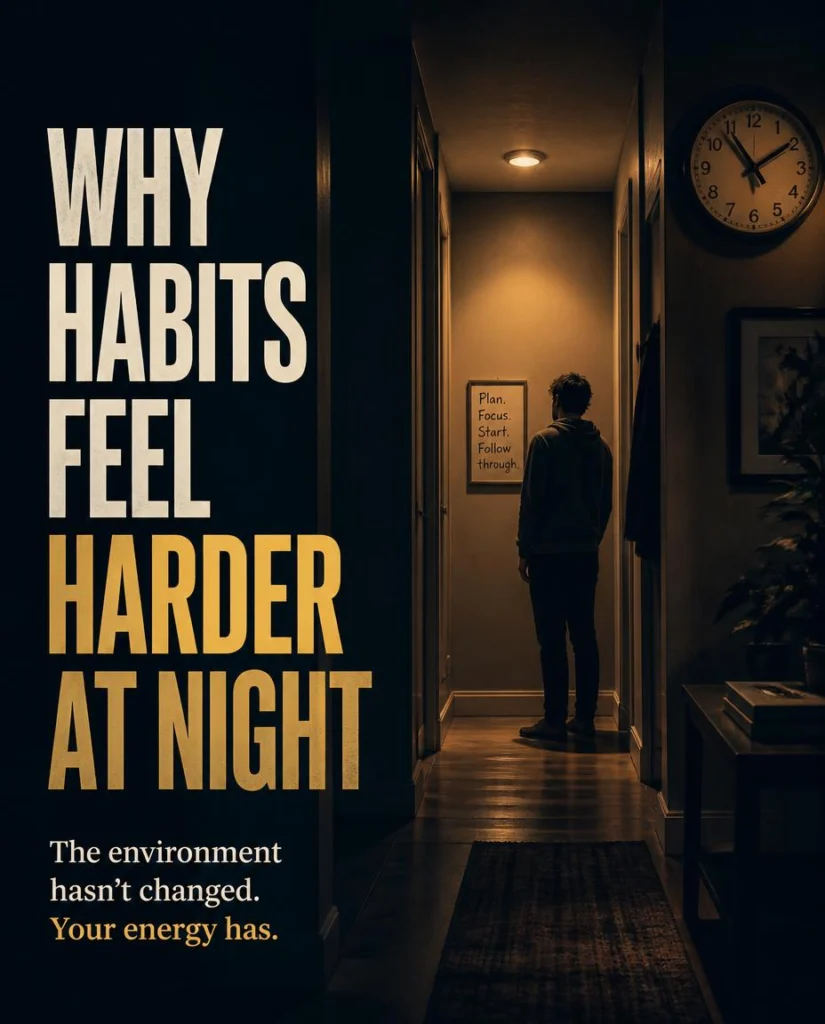
Habits at night feel harder for a simple reason: your day has already used your attention.
You wake up motivated. You eat well, stay on track, and feel good about the day. And then evening arrives. Suddenly, the decisions that felt easy at noon feel heavy. The snack you didn’t want at 2 PM looks irresistible at 9 PM. The routine you planned feels impossible.
This isn’t a character flaw. It’s biology.
Why Habits at Night Feel Different
Every decision you make during the day — what to eat, what to skip, what to resist — draws from the same mental reserve. By evening, that reserve is empty.
Psychologists call this decision fatigue. Research shows that self-control is a limited resource that depletes with use. The more choices you make during the day, the less mental energy remains for resisting temptation later.
By evening, decisions can feel heavier — not because you’re weak, but because you’re tired.
The Trap of Treating Every Moment as a Character Test
Most people respond to nighttime struggles by demanding more from themselves: “I just need more discipline.” “I’ll try harder tomorrow.” “I should be stronger than this.”
But this approach fails because it treats a context problem as a character problem. If you’re exhausted, stressed, and surrounded by easy temptations, no amount of willpower will fix what a better environment could solve. This is why habits at night often feel impossible to control.
What Actually Helps
Instead of demanding more willpower, try designing your evening differently.
1. Design Your Environment
Your environment is stronger than your willpower. If there are snacks in the cupboard, you’ll eventually eat them. If they’re on the counter, you’ll eat them faster. If they’re not in the house at all, the decision disappears.
Make the healthy choice the easy choice. Put fruit where you can see it. Move the biscuits to a high shelf. Don’t rely on discipline — remove the temptation entirely.
2. Plan for Your Lowest Energy Point
Don’t plan your evening as if you’ll have morning energy. Plan it as if you’ll be tired, distracted, and tempted. What will you do when the urge arrives? What’s already prepared? What can you decide in advance so you don’t have to decide in the moment?
Pre-decide. Preparation removes friction.
3. Have a “When This Happens, I Will…” Plan
Instead of relying on how you feel, create a simple if-then rule:
- “When I feel the urge to snack at night, I will drink a glass of water first.”
- “When I finish dinner, I will brush my teeth.”
- “When I sit on the couch, I will have tea instead of dessert.”
These small, pre-decided rules reduce the mental load and make the better choice automatic.
4. Stop Punishing Yourself for Being Human
You are not weak because you’re tired at night. You’re human. Every person’s willpower depletes. The goal isn’t to become a machine that never struggles — it’s to build a system that works even when you’re tired.
The Identity Connection
This is where the Identity Shift Method comes in. If you see yourself as someone who “always fails at night,” you’ll keep proving that story. But if you see yourself as someone who plans ahead, who designs their environment, who respects their own limits — then evening stops being a test and starts being a routine.
You don’t need more willpower. You need a different relationship with your evenings.
If this resonates with you, I’ve created a free 5-minute reflection to help you see the patterns behind your habits — including the ones that show up at night.
👉 Download The 5-Minute Identity Check here
And if you want to go deeper, the complete system — the book, the workbook, and the 30-day journal — is available here:
👉 Get The End of Dieting Collection
Mind Before Body.
Conclusion
Habits at night aren’t a reflection of your character. They’re a reflection of your context. Not every difficult moment is a willpower problem — sometimes timing, environment, and mental energy matter more than effort.
Instead of trying harder, try designing smarter. Change the context — and the behavior follows.
Ready to stop fighting your evenings and start designing them?