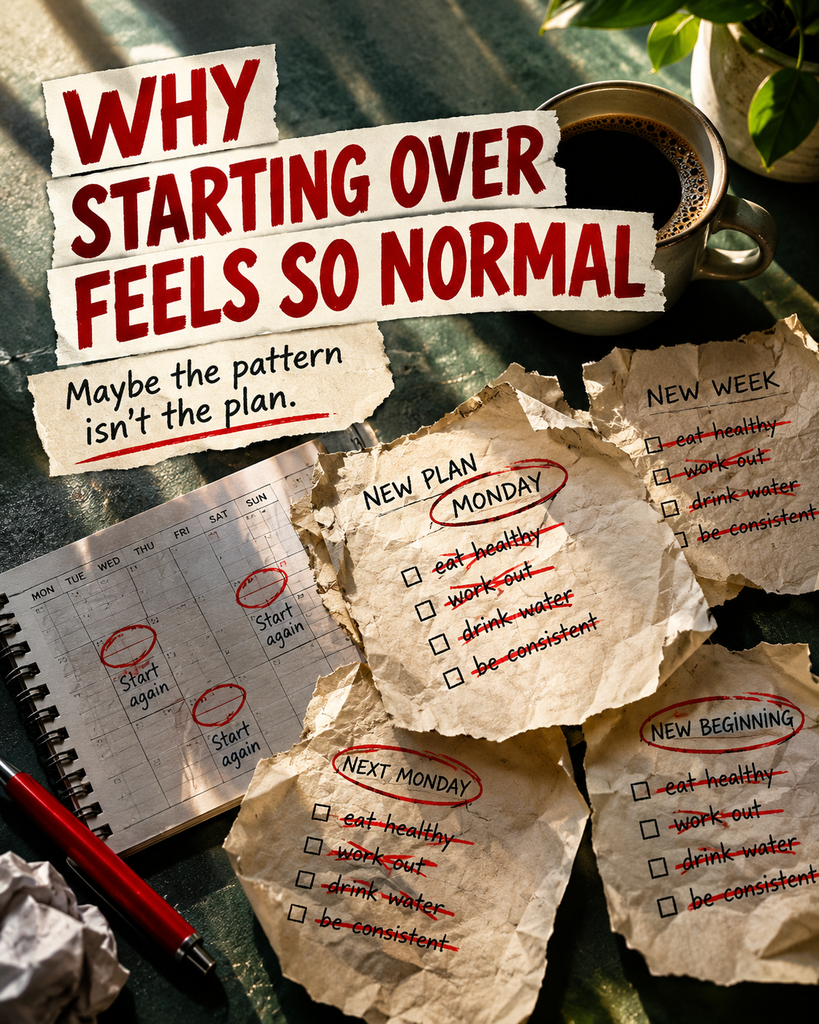
Why Starting Over Feels So Normal
Why starting over feels so normal is a question many of us ask ourselves — especially after yet another “failed” attempt at change. If you’ve ever found yourself saying “I’ll start again on Monday” — and meant it — you’re not alone. In fact, you’re experiencing one of the most well-documented psychological phenomena in behavioral science. Understanding why starting over feels so normal is the first step toward breaking the cycle.
In this article:
- The Fresh Start Effect
- Why Starting Over Feels So Good (At First)
- The Dark Side of the Fresh Start Effect
- The All-or-Nothing Trap
- Resets vs. Recovery
- Why the Pattern Is Deeper Than the Plan
- What to Do Instead
- Final Thought
The Fresh Start Effect: Why Starting Over Feels So Normal
Behavioral scientists have a name for that surge of motivation you feel on January 1st, a Monday morning, or the first day of a new month. They call it the “Fresh Start Effect.”
Researchers Dai, Milkman, and Riis found that gym visits, Google searches for the word “diet,” and commitments to pursue goals all spike following temporal landmarks — moments like the start of a new week, a new month, a birthday, or a holiday.
Why starting over feels so normal comes down to how our brains process time. These milestones act as the start of new “mental accounting periods.” They help us relegate past imperfections to a previous period and take a big-picture view of our lives.
“In fresh start moments, people feel more distant from their past failures,” says Katy Milkman, one of the lead researchers.
In other words: the score resets to zero-to-zero. And it’s much easier to feel motivated when you’re not already down by ten points. This is exactly why starting over feels so normal to so many people.
Why Starting Over Feels So Good (At First)
There’s a reason the “Monday reset” feels so satisfying. It creates a sharp line between what feels “bad” or failed and what’s imagined as “good” or fixed.
As one Psychology Today article notes: “Starting over can feel calming because it creates a sharp line between what feels ‘bad’ or failed and what’s imagined as ‘good’ or fixed.”
It’s a form of psychological permission — a clean slate. The past failures get filed under the “old self,” and the “new self” gets a fresh ledger. This is why so many people ask themselves “why do I keep starting over?” — without realizing that the answer lies in how good it feels to begin.
But here’s the catch: the same mechanism that makes a fresh start feel powerful is the one that quietly sabotages it three weeks later.
The big-picture view that makes a goal feel exciting on January 1st is terrible at sustaining it through the boring daily mechanics of February. The motivation fades, the routine breaks, and before you know it, you’re waiting for the next Monday to start again.
The Dark Side of the Fresh Start Effect
While fresh starts can be helpful, there’s a dark side. As one fitness expert warns: “We need to be careful that we aren’t ‘starting a new diet’ every morning.”
That’s the trap.
When starting over becomes a pattern rather than a one-time launchpad, it stops being useful and starts being a cycle. This is the starting over habit cycle that keeps people stuck for years.
Gretchen Rubin, author and habits expert, calls this being a “chronic fresh-starter” — someone who gets energized by beginnings but never follows through.
She warns against using clean slates as “escape hatches” rather than launching pads. The problem with the starting over habit cycle is that it feels productive while actually keeping you in the same place.
The All-or-Nothing Trap
At the heart of the restart cycle is often all-or-nothing thinking.
This cognitive style — seeing things as “either-or” rather than on a continuum — is common among people who struggle with dieting and behavior change. To understand why starting over feels so normal, we need to look at all-or-nothing thinking.
When you’re operating in all-or-nothing mode, one slip-up feels like total failure. And total failure demands a total restart. This is the fresh start effect psychology at its most destructive.
This pattern is great for the weight-loss industry — companies depend on restarts. But it’s terrible for you. It keeps you cycling through the same loops of weight loss and regain.
Resets vs. Recovery
There’s an important distinction between a reset and a recovery-oriented shift.
A reset often means:
- Returning to restriction and rigidity
- Doubling down on rules
- Language like “I’m going to be good” — which signals a moralized approach
- Urgency and low tolerance for error
A recovery-oriented shift looks different:
- It’s collaborative and reality-based
- It incorporates what was learned from previous attempts
- It’s accompanied by increased support and clearer expectations, not increased self-pressure
When resets inevitably break down, the outcome is increased shame and reinforcement of beliefs about personal failure. This is why why starting over feels so normal is such an important question to ask — because the answer reveals the difference between a helpful reset and a harmful cycle.
Why the Pattern Is Deeper Than the Plan
Starting over feels normal because it’s wired into how our brains process time and failure. The Fresh Start Effect is a real psychological force. So why starting over feels so normal isn’t a personal failing — it’s human nature.
But the pattern is deeper than the plan.
Constantly restarting isn’t a sign that you lack willpower. It’s a sign that you’re relying on a system — fresh starts and resets — that was never designed to create lasting change. This is the fresh start effect psychology in action.
The question isn’t “Why can’t I stick to this plan?” The question is: “What keeps bringing me back to the starting line?”
Once you understand why starting over feels so normal, you can start breaking the restart cycle for good.
What to Do Instead
- Stop waiting for Monday. You don’t need a perfect moment to begin again. Why starting over feels so normal is partly because Mondays feel like permission — but you don’t need permission.
- Build for ordinary days, not best days. A plan that only works when everything is perfect is a plan that will fail. Understanding why starting over feels so normal helps you see why most plans don’t survive real life.
- Learn from setbacks instead of erasing them. A setback is information — it shows you where the pattern needs attention. Instead of asking “why do I keep starting over?” ask “what can I learn from this?”
- Shift from goals to identity. Instead of asking “What do I want to achieve?” ask “Who am I becoming?” This shift is the key to breaking the restart cycle.
- Break the all-or-nothing cycle. Real life happens somewhere in the middle. The fresh start effect psychology is powerful, but it works best when combined with realistic expectations.
Final Thought
Why starting over feels so normal is because it’s designed to feel that way. Your brain loves a clean slate. The promise of a fresh start is seductive, and there’s genuine psychological relief in drawing a line under past failures. This is the fresh start effect psychology at work.
But lasting change isn’t built on resets. It’s built on returning. On imperfect consistency. On learning from what didn’t work instead of pretending it never happened.
You don’t need another Monday. You need a starting point that fits real life — and the willingness to keep going even when it doesn’t look perfect.
Once you understand why starting over feels so normal, you can finally stop asking “why do I keep starting over?” and start building something that actually lasts.
Ready to break the cycle? 👉 Explore The End of Dieting approach
This post is part of The End of Dieting — a different approach to understanding behavior, patterns, and lasting change.