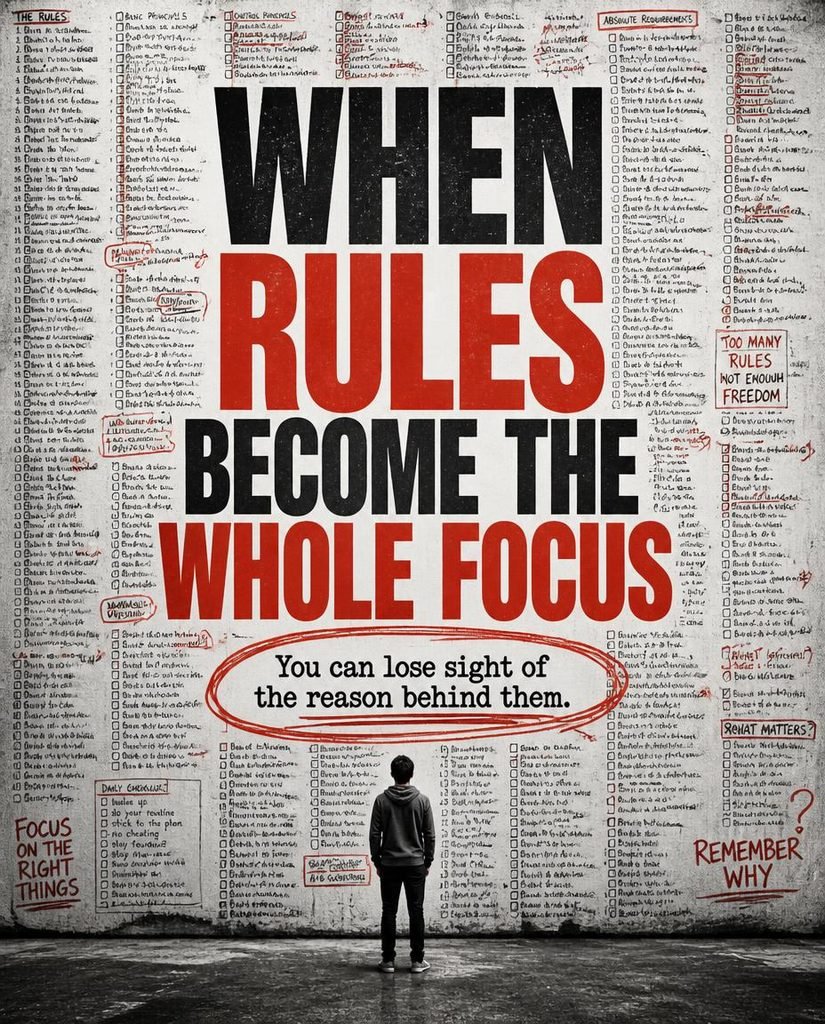
The more food rules we create, the more attention food can demand.
It starts innocently enough. You decide to cut out sugar. Then you read that carbs are the enemy, so you cut those too. Then you add a rule about intermittent fasting, then a rule about only eating organic, then a rule about not eating after 6 PM.
Suddenly, every decision starts feeling like a test. And eventually, the rules can become the entire focus.
The Trap of Constant Rules
More rules don’t automatically create better behavior. Sometimes, constant attention to rules can make food feel even more central to everyday life.
When you have a list of “allowed” and “forbidden” foods, you stop eating intuitively. You stop listening to your body. Instead, you start calculating. You start negotiating. You start living in your head instead of in your body.
This is why restrictive dieting often backfires. The mental load of keeping track of all those rules becomes exhausting. And when you’re exhausted, you don’t make better choices – you make the easiest choice.
Why Restriction Creates Obsession
There is a psychological principle called the “ironic process theory.” It states that trying to suppress a thought actually makes that thought more frequent and intrusive.
If I tell you “Don’t think about chocolate,” what is the first thing that pops into your head? Chocolate.
The same thing happens with food rules. The more you forbid something, the more you crave it. The more you make food the enemy, the more it occupies your mind. You start to feel like you are constantly at war with your own appetite.
But food isn’t the enemy. The real problem isn’t the food itself – it’s the system of rules you’ve built around it.
Shifting Focus from Rules to Identity
This is where the Identity Shift Method changes the game.
Instead of asking “What are the rules for this diet?” you ask “Who am I becoming?”
If you are someone who takes care of their body, you don’t need a rule telling you not to eat a whole cake in one sitting. It’s not a restriction – it’s simply not what that person does.
When you change your identity, you don’t need to rely on a complex set of rules. You rely on a simple internal compass. You eat when you’re hungry, you stop when you’re full, and you enjoy food without guilt. The rules become irrelevant because the behavior is now part of who you are.
So, instead of adding more food rules, try simplifying your system.
A useful lesson from behavior science is that adding more instructions doesn’t necessarily make a behavior easier. In fact, complexity increases friction. When a change requires constant mental effort, sustainability becomes harder.
So, instead of adding more rules, try simplifying your system. Focus on one or two core principles that align with your new identity. For example: “I eat when I’m hungry and stop when I’m full.” That’s it. No forbidden foods. No complicated macros. Just a simple, repeatable guideline that you can live with.
According to a 2023 meta-analysis of 97 studies, loosening rigid food rules and adopting a more intuitive approach is linked to better mood, healthier eating behaviors, and a markedly lower mental burden. Fewer rules appear to mean fewer looping thoughts. The mental energy you free up can then be used for things that actually matter to you.
Conclusion
More food rules aren’t automatically better. Sometimes they simply make food decisions take up more mental space.
If you want to create lasting change, stop adding more restrictions. Start focusing on who you are becoming. Simplify your system, trust your body, and let your identity guide your choices – not a rulebook.
Ready to simplify your approach to food? Learn more about the Identity Shift Method and get your copy of The End of Dieting → endofdieting.com
If you’re tired of waiting for the perfect moment to start, read why you don’t need a perfect Monday to begin.