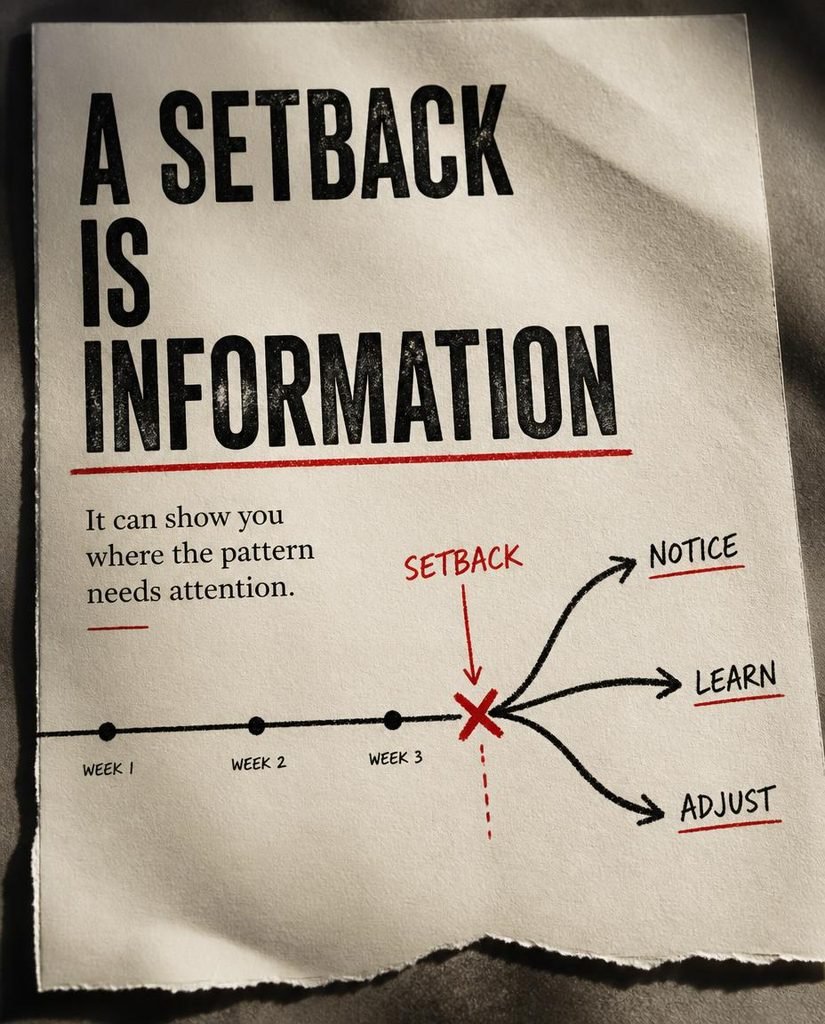
A setback doesn’t have to mean the plan failed. It can tell you where the plan doesn’t fit real life. And that’s information you can actually use.
Most people treat a setback as proof. Proof that they can’t change. Proof that they’re weak. Proof that nothing works. But a setback isn’t a verdict. It’s data. And if you know how to read it, it becomes one of the most useful tools you have.
The Problem With Treating a Slip as Failure
When you see a setback as failure, you do two things. First, you feel bad about yourself. Second, you stop looking for what actually went wrong. The story becomes “I failed” instead of “something didn’t work” – and that story closes the door on learning.
But here’s the truth: a setback doesn’t have to mean the plan failed. It can tell you where the plan doesn’t fit real life. That’s information you can use. This is why motivation is not a plan – it’s just a feeling. And feelings change. What matters is what you do next.
What a Difficult Moment Actually Tells You
Every setback is a signal. It’s telling you something. It might be telling you that:
- The plan was too strict for a busy week
- The environment made the old choice too easy
- You were tired, stressed, or overwhelmed
- A specific trigger caught you off guard
- The routine doesn’t survive real life
When you ask “what did this teach me?” instead of “why can’t I do this?”, you turn a setback into a lesson. And lessons are how you build a better system.
How to Read the Signal
Instead of asking “why can’t I do this?” try asking “what did this moment teach me?”
1. Separate the Event from the Story
The event is what happened. “I ate a biscuit at 10 PM.” The story is what you told yourself about it. “I always ruin my progress.” One is a fact. The other is an interpretation. You can choose a more useful one.
2. Look for the Pattern, Not the Failure
A single setback isn’t a pattern. But three setbacks in the same situation? That’s a pattern. And patterns are solvable. If you keep slipping at night, the problem might not be willpower – it might be that habits at night are harder because your mental energy is gone. And if you keep slipping because of one imperfect choice, that’s the all-or-nothing trap – not a character flaw.
3. Ask What the Plan Missed
Instead of blaming yourself, ask what the plan didn’t account for. Was it too rigid? Too unrealistic? Did it ignore the fact that you’re human? When a plan fails, the plan is often the problem – not the person following it.
4. Adjust, Don’t Abandon
Most people respond to a setback by either giving up completely or starting over from scratch. But the better response is to adjust. Change one thing. Make the plan more realistic. Try again tomorrow, not next Monday. That’s what habits don’t need to be huge really means – they just need to be repeatable.
The Lesson Inside the Slip
Every setback is a teacher. It shows you where the system breaks. It shows you what real life actually looks like. It shows you what you still need to work on. And that’s a gift, even if it doesn’t feel like one in the moment.
The people who succeed long-term aren’t the ones who never have setbacks. They’re the ones who learn from them. They treat setbacks as information, not as verdicts. And they keep adjusting until the system fits their real life.
The Identity Connection
This is where the Identity Shift Method comes in. A setback doesn’t change who you are. It’s just one moment in a much longer story. But the way you respond to a setback does shape your identity. Every time you choose to learn instead of give up, you’re casting a vote for the person you’re becoming – the person you believe you are.
One Question to Sit With
Think about your last setback. If you treated it as information instead of failure, what would it tell you?
Conclusion
A setback isn’t a verdict. It’s information. It’s telling you where the plan doesn’t fit, where the environment needs adjusting, where the system needs work. Listen to it. Learn from it. Then adjust.
Don’t let one moment become your identity. You are not your worst day. You are someone who is still learning, still adjusting, and still becoming.
And if the voice in your head is telling you otherwise, remember – self-criticism doesn’t create change. It just keeps you stuck.
Ready to stop treating setbacks as failure and start using them as information?
If this resonates with you, start with the free 5-Minute Identity Check. Download the free PDF here.
And if you want the complete system — the book, workbook, journal, and action guide — get The End of Dieting Collection
Mind Before Body.