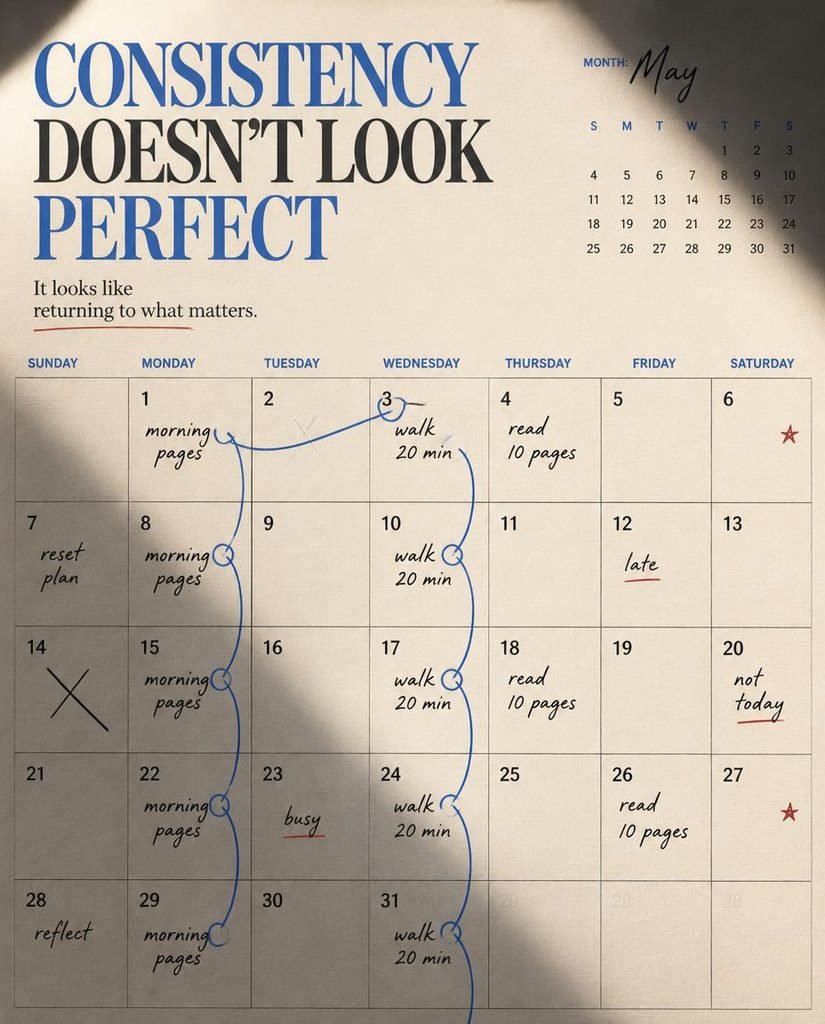
Consistency isn’t perfection. It never was. It’s the ability to return – again and again – to the person you’re becoming. That’s a very different definition. And it’s the one that actually works.
The Problem With the Perfect Version
Most people think consistency means every day looks the same. No missed workouts. No off-plan meals. No bad days. That version of consistency sounds inspiring – until you try to live it.
Because real life doesn’t work that way. You get sick. You travel. You have a stressful week. Your kid gets sick. Your job gets busy. And suddenly, the “perfect streak” breaks. And when the streak breaks, most people don’t just slip – they quit entirely.
This is the all-or-nothing trap in its most common form: the belief that if you can’t do it perfectly, it’s not worth doing at all.
A Different Definition
Here’s what consistency actually means: returning.
Not never missing a day. Not never eating the biscuit. Not never slipping. But coming back after you do.
Consistency isn’t a perfect line. It’s a wavy one – with dips, gaps, and returns. The people who succeed long-term aren’t the ones who never miss. They’re the ones who always come back.
This is what a setback is information really means. Every slip teaches you something. And every return is evidence that you’re still on the path.
Why “Returning” Works Better Than “Perfect”
There’s a simple reason. Perfect requires everything to go right. Returning only requires you to show up again — even imperfectly.
- If you miss a workout, returning means going for a walk tomorrow.
- If you overeat at dinner, returning means eating normally at breakfast.
- If you skip a week, returning means starting again today, not next Monday.
That’s it. No penance. No punishment. Just the next small choice. This is what self-criticism doesn’t create change really means – punishing yourself doesn’t make you more consistent. Returning does.
How to Build the Return Habit
1. Expect to Miss
Stop pretending you’ll never slip. Plan for it. Assume that a day will come when you break the pattern. The question isn’t “Will I slip?” It’s “What will I do when I do?”
2. Have a “Return Rule”
Create one simple rule for yourself: “If I miss a day, I return the next day. No exceptions. No starting over from scratch.” This is what makes consistency sustainable.
3. Shrink the Return
The return doesn’t have to be dramatic. A five-minute walk is a return. One glass of water is a return. One meal eaten slowly is a return. Habits don’t need to be huge – they just need to be repeatable.
4. Don’t Restart, Continue
You’re not “starting over.” You’re continuing. There’s a difference. Restarting erases everything that came before. Continuing builds on it.
This is why why starting over feels so normal is such a trap. Every restart erases progress. Every return keeps it.
The Identity Connection
Here’s where it matters most: every time you return, you’re casting a vote for a new identity. Not the identity of “someone who does everything perfectly.” The identity of “someone who doesn’t give up.”
That’s a much stronger, much more real identity. It’s also the one that survives real life.
When you see yourself as the person you believe you are – someone who returns – you stop needing perfection. You just keep showing up.
One Question to Sit With
If you gave up the idea of a perfect streak and focused only on returning, what would change?
Conclusion
Consistency doesn’t look perfect. It looks like returning. Again and again. Quietly. Without drama. Without punishment. Without starting over.
That’s how lasting change actually happens – not in one perfect month, but in a hundred imperfect returns.
Ready to stop chasing perfect and start practicing the return?
If this resonates with you, start with the free 5-Minute Identity Check. Download the free PDF here.
And if you want the complete system — the book, workbook, journal, and action guide — get The End of Dieting Collection
Mind Before Body.