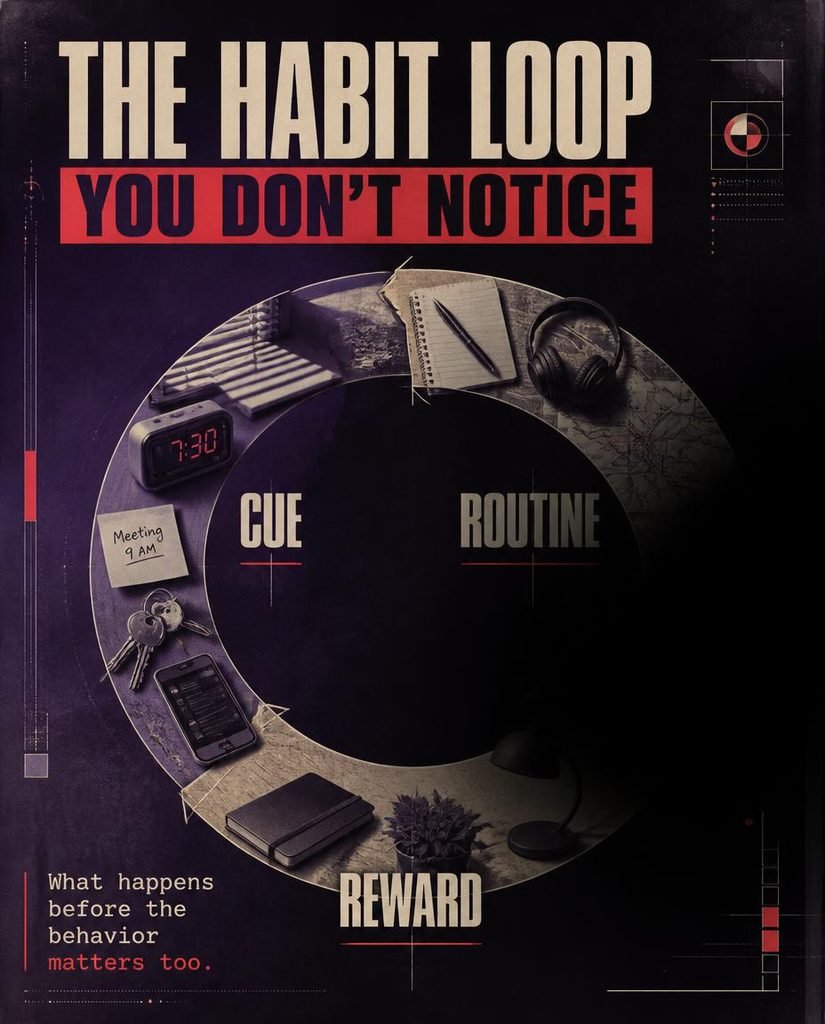
Most habits begin before you consciously decide anything. A cue appears, the routine follows, and the brain quietly learns the pattern. By the time you notice what happened, the behavior is already over.
Understanding the habit loop is what gives you somewhere to intervene..
What the Habit Loop Actually Is
Every habit loop – good or bad – follows the same three-part structure:
Cue → Routine → Reward
- Cue: something that triggers the behavior. A time of day, a place, an emotion, a person, a sound.
- Routine: the behavior itself. What you actually do.
- Reward: the payoff. The relief, comfort, pleasure, or distraction the behavior provides.
When this habit loop repeats often enough, the brain stops treating it as a decision and starts treating it as a default. You don’t choose to open the fridge at 9 PM. You just find yourself standing there.
Why You Don’t Notice It
The habit loop is invisible because it happens below the level of conscious decision.
By the time you become aware of the behavior – “Wait, why am I eating this?” – the cue has already fired, the routine has already started, and the reward is already within reach.
This is why willpower rarely works against habits. Willpower arrives too late. By the time you’re aware there’s a decision to make, the decision has already been made somewhere deeper.
The Cue Is the Key
Most people try to change the routine inside the habit loop. That’s the hardest place to intervene, because by the time you’re in the routine, the momentum is already there.
The easiest place to intervene is at the cue.
If you can learn to notice what happens immediately before the behavior, you suddenly have a moment of choice – a small gap between the cue and the routine where something different can happen.
This is what a setback is information really means. Every time you slip, you learn something about your cues. Every cue you notice is a place you can work.
How to Notice Your Cues
1. Ask “What happened right before?”
Not “why did I do that?” – that question judges. Ask instead: “What happened in the sixty seconds before I started?” Where were you? What time was it? What were you feeling? Who was there?
The answer is usually your cue.
2. Look for Patterns, Not One-Offs
One slip tells you almost nothing. But five slips in the same situation? That’s a pattern. And patterns have cues you can find.
This is why your environment is part of your habit — most cues are physical, not emotional.
3. Name the Emotion, Not Just the Action
Often the cue is a feeling, not a place. Stress. Boredom. Loneliness. Tiredness. Frustration. These are just as real as a kitchen or a time of day — and they’re just as predictable once you start paying attention.
4. Notice the Reward
What does the behavior actually give you? Relief? Comfort? A break? A distraction? Knowing what the reward is helps you understand why the loop keeps firing. And it tells you what you actually need.
What to Do With the Cue
Once you know your cues, you have three options:
1. Remove the cue. If the cue is a snack on the counter, take the snack off the counter.
2. Interrupt the cue. If the cue is walking into the kitchen at 9 PM, do something else at 9 PM. Change the routine by changing the environment around the cue.
3. Replace the reward. If the cue is stress and the reward is relief, find another way to get relief. A walk. A breath. A call. The cue doesn’t have to lead to the same routine.
None of this requires willpower. It requires noticing. And noticing is a skill you can build.
The Identity Connection
Every time you notice a cue, you’re proving something to yourself: you are not on autopilot. You have a say.
That’s what the Identity Shift Method is built on. You’re not just trying to control behavior – you’re becoming someone who notices their patterns, understands them, and chooses differently.
And when you become that person, the old habits lose their grip. Not because you’re fighting them harder – because you’re no longer running on autopilot.
This is also why consistency doesn’t look perfect. The goal isn’t to never slip. The goal is to keep noticing – even on the days you don’t get it right.
One Question to Sit With
What happens immediately before one of your habits? If you had to name the cue right now, what would it be?
Conclusion
Your habits aren’t random. They follow a habit loop: cue, routine, reward. And once you learn to see the loop, you can finally do something about it.
Not by trying harder. By noticing earlier.
Start with one habit. Just one. Find the cue. That’s where the change begins.
Ready to stop running on autopilot and start noticing your own patterns?
If this resonates with you, start with the free 5-Minute Identity Check. Download the free PDF here.
And if you want the complete system — the book, workbook, journal, and action guide — get The End of Dieting Collection
Mind Before Body.