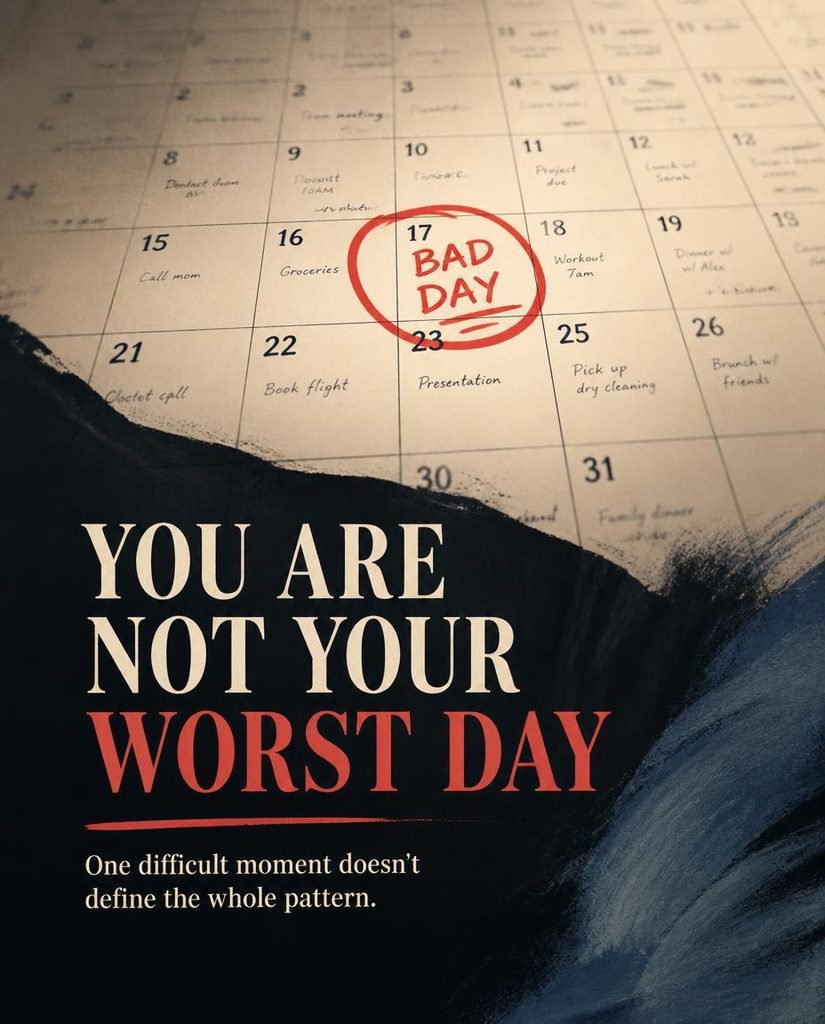
You are not your worst day. Read that again – because it’s the sentence most people forget the moment a difficult morning arrives. There’s a specific kind of morning that most people who’ve struggled with food know too well.
You wake up. The day before wasn’t terrible – but it wasn’t good either. Maybe you ate something you’d told yourself you wouldn’t. Maybe you skipped the walk. Maybe you just felt off, and food was the easiest answer at the time.
And before you’ve even had coffee, a sentence arrives fully formed:
“I always do this.”
Not “I did this yesterday.” Not “that was a hard moment.” Just: I always do this.
That sentence feels true. It feels honest. But it’s not a description of what happened. It’s a description of who you’ve decided you are.
And that’s the real problem – not the food, but the verdict. You are not your worst day — but it takes work to actually believe that.
You Are Not Your Worst Day (And Here’s Why That Matters)
The mind doesn’t treat a bad moment like data. It treats it like evidence.
If you’ve had a hundred better days and one hard one, you’d think the ratio would matter. It doesn’t, at least not emotionally. The bad moment is the one that sticks, because it confirms something you were already afraid of.
Psychologists call this confirmation bias – the tendency to notice and remember information that fits an existing belief, while ignoring information that contradicts it. If you already suspect you’re “someone who always caves,” one slip becomes proof. The fifty times you didn’t slip? Not even registered.
So the bad day doesn’t create the story. The story was already there, waiting for a bad day to land on.
That’s why the moment feels so heavy. It’s not the food. It’s the confirmation.
A Moment Is Not a Pattern
Here’s the distinction that actually matters:
A moment is what happened. A pattern is what happens repeatedly, over time.
One skipped workout isn’t a pattern. One late-night snack isn’t a pattern. One week where things fell apart isn’t a pattern.
A pattern is what shows up across months — and here’s the thing: most people who believe they “always do this” have never actually looked at the pattern. They’ve only looked at their worst days, because those are the ones that hurt enough to remember.
If you actually tracked your days for a month, you’d probably find something surprising: you didn’t always do this. You did it sometimes. That’s a very different sentence, and it changes what you do next.
You can read more about this idea in A Setback Is Information (Not a Verdict), where we look at what a difficult moment actually tells you — and what it doesn’t.
The Moment Is Real. The Verdict Is Optional.
A bad day is not a lie. It happened. The food happened. The feeling happened. Ignoring it wouldn’t help – that’s just another way of pretending.
But between the moment and the meaning, there’s a step that most people skip. It’s the step where you decide what the moment means.
The moment can mean:
- “I’m exhausted and I reached for the easiest thing.”
- “This week has been heavy and I stopped paying attention.”
- “I had a hard day. That’s it.”
Or it can mean:
- “I’m someone who always does this.”
- “I’ll never change.”
- “See? This is who I am.”
Same moment. Two completely different meanings. One moves you forward. The other buries you in a story that wasn’t even true.
This is where the phrase you are not your worst day stops being a nice idea and becomes a practical tool. Because if you are not your worst day, then your worst day doesn’t get to write the ending.
What the Pattern Actually Looks Like
If you stop looking at single days and start looking at months, you almost always find something different from what you feared.
You find that the difficult moments cluster around specific conditions – bad sleep, high stress, certain people, certain times of day. You find that the same small triggers show up again and again.
And you find that the pattern isn’t “I always fail.” The pattern is: “When X happens, I tend to respond with Y.”
That’s a completely different sentence. It’s specific. It’s fixable. And it points to what to actually do next – not to your identity.
This is where the work shifts. You stop asking “what’s wrong with me?” and start asking “what conditions keep showing up?”
For more on that shift, read Self-Criticism Doesn’t Automatically Create Change – because self-blame rarely produces the change people hope it will.
The One Question That Breaks the Spell
When the sentence “I always do this” arrives, try replacing it with a smaller, more honest question:
“What happened right before?”
Not what does this say about me. Not what does this mean about my whole life. Just: what happened right before?
You’ll usually find something specific. A hard conversation. A skipped lunch. A long day without a break. A night of bad sleep.
And once you see that, the moment stops being a verdict. It becomes information – useful, specific, and workable.
That’s the difference between a bad day and a bad identity. A bad day is a data point. A bad identity is a sentence you keep repeating until it feels like a fact.
You can read more about this shift in Consistency Doesn’t Look Perfect – because the people who actually change are rarely the ones who never slip. They’re the ones who stopped turning a slip into a story.
What to Do the Day After
If yesterday was hard, today doesn’t need to be a fresh start. That framing is part of the problem – it turns every hard day into a cliff you have to climb back up from.
Instead, today can just be today.
You don’t need to redeem yesterday. You don’t need to be stricter, cleaner, or more disciplined to make up for it. You just need to do one ordinary thing that fits the person you’re becoming.
A glass of water before a meal. A fifteen-minute walk. A meal eaten at the table, without a screen.
Not because it erases yesterday. Because it’s what today looks like – and today is the only day actually on the table.
The research on self-compassion is clear here: people who treat themselves with understanding after a difficult moment are more likely to return to healthy behavior, not less. The verdict doesn’t help. The return does.
Mind Before Body
You are not your worst day. One difficult moment doesn’t define the whole pattern.
It feels like it does, because the mind treats bad days like proof. But a bad day is a moment. A pattern is what you do most of the time. And most of the time, you’re doing better than you think.
The next time the sentence arrives – “I always do this” – pause. Ask: is this a fact, or is this a feeling that showed up because I’m tired?
If it’s the second one, you already know what to do. You don’t need a new plan. You need to stop mistaking a moment for a verdict.
That’s the whole shift. Mind before body.
If this resonates with you, start with the free 5-Minute Identity Check.
And if you want the complete system – the book, workbook, journal, and action guide – get The End of Dieting Collection
Mind Before Body.